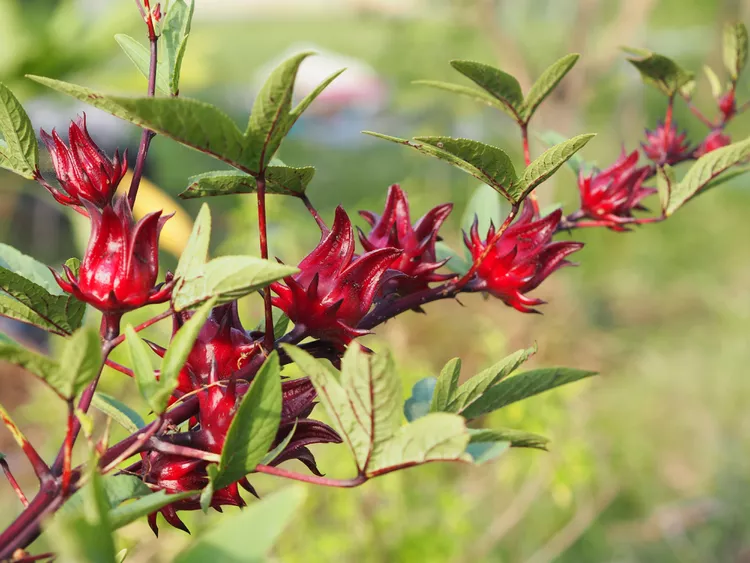
Roselle is an ornamental plant related to okra. While the entire plant is edible, roselle is most often grown for its burgundy calyxes that develop at the base of the flower. The calyx, which protects the flower bud before bloom, is very showy after the roselle flowers fade—fleshy and deep red. These are harvested to make a bright red tea with a tart, fruity flavor similar to cranberry, rhubarb, or citrus. Roselle is included in many herbal tea blends and is used to make other beverages, including Bissap, the national drink of Senegal, and jellies, syrups, and sauces. Young leaves make a spicy addition to salads or can be cooked like spinach.
Although it is perennial in very warm climates, roselle is grown in most regions as an annual. It has an upright, multistemmed habit; its attractive lobed leaves are held on red stems. Its 3-inch wide creamy white hibiscus-like flowers sport deep red centers. Although each bloom lasts for just a day, a continuous parade of flowers appears from midsummer to frost.
Roselle Overview
| Genus Name | Hibiscus sabdariffa |
| Common Name | Roselle |
| Additional Common Names | Florida Cranberry, Red Sorrel |
| Plant Type | Perennial |
| Light | Sun |
| Height | 4 to 7 feet |
| Width | 2 to 4 feet |
| Flower Color | White, Yellow |
| Foliage Color | Blue/Green |
| Season Features | Fall Bloom, Summer Bloom |
| Special Features | Low Maintenance |
| Zones | 10, 11, 9 |
| Propagation | Seed, Stem Cuttings |
| Problem Solvers | Good For Privacy |
Where to Plant Roselle
Roselle can be planted in your vegetable garden or as a tall background plant in a sunny annual flower bed. It also creates an excellent, fast-growing hedge to separate garden spaces or a screen to disguise an eyesore. Because it can reach 6 or 7 feet tall, avoid siting it where it will shade out other sun-loving plants. On a sunny deck or patio, it can be grown in large containers. For any of these uses, remember that you will want easy access to harvest the calyxes and that this large shrub-like annual requires a good bit of space.
How and When to Plant Roselle
Plant roselle in late spring or early summer, about the same time you set out pepper and tomato seedlings. Space plants 24 to 36 inches apart in well-prepared soil. Keep your new plants watered and the area weed-free until your roselle is established. A layer of mulch will help maintain moisture and reduce weeds. Plants grow quickly and will eventually shade out weeds.
Roselle Care Tips
Roselle requires minimal maintenance as long as it gets plenty of sun and supplemental water when there's little rain. It’s a fast grower, so give it plenty of space.
Light
Roselle needs full sun (more than 6 hours per day) to produce flowers. Shade will reduce its bloom and therefore, its production of calyxes. In regions with very hot summers, it benefits from some afternoon shade.
Soil and Water
Any well-drained soil with a fairly neutral pH will do for roselle. When you transplant it into the garden, water regularly until it becomes established when its deep root system makes it drought tolerant. It will, however, do best when watered during extended dry spells.
Temperature and Humidity
Roselle is native to tropical regions, and in USDA Hardiness Zones 9-11, it can be grown as a perennial, but in Zones 5-8, it is treated as an annual. It shouldn’t be planted outdoors in temperate zones until the weather has warmed—at least 2 to 3 weeks after the last spring frost date. It may be stunted by cool weather and is very sensitive to frost and freezing, which will kill the plant. Be sure to harvest calyxes before the first fall frost. It grows best in regions with high summer humidity.
Fertilizer
Before planting, work some compost or balanced, slow-release fertilizer into the soil. Additional fertilization is not usually required and may cause plants to grow tall with abundant leaves but few flowers. Avoid overfertilizing.
Pruning
Though not essential, pruning young roselle plants will cause them to develop more side shoots and become bushier, often increasing their flower production. When the stems are about 18 inches long, simply remove 2 to 3 inches, making the cut just above a node. Unpruned plants may need staking.
How to Propagate Roselle
Roselle is usually grown from seeds sown indoors about six weeks before the last frost date. Plant seeds in individual pots, two per pot, and cover lightly with potting mix. Seeds germinate quickly, usually within two weeks. Thin to the strongest seedling when it has developed a few leaves. Transplant when the weather has warmed, about the same time you set out your tomato and pepper plants. Once the soil has warmed, Roselle can be sown directly in the garden in areas with a long growing season.
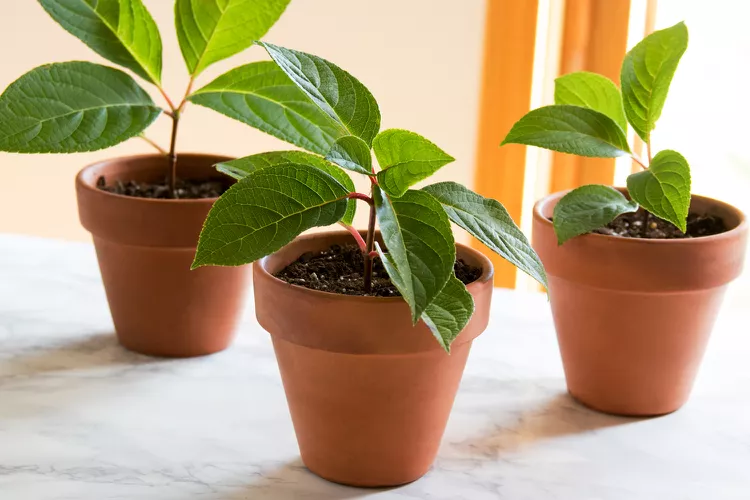
Roselle can also be propagated by stem cuttings. Cut 5- to 6-inch-long stems, making your cut just below a node. Remove large leaves, leaving a couple of smaller ones near the top of the cutting. Place the bottom 3 or 4 inches of the cutting in well-draining potting soil. Roots will begin to form after two to three weeks.
Pests and Problems
Few pests or diseases trouble roselle. Aphids may cause some damage to leaves, but treatment is not usually necessary. A hard spray of water will often reduce aphid populations sufficiently.
Root knot nematode can sometimes infect plants; the best solution is to rotate the crop yearly. Overwatering can cause root rot. Be sure to plant in well-draining soil.
Types of Roselle
Although often sold simply as roselle (or Hibiscus sabdariffa) there are a few named varieties (some may be difficult to find).
Burmese roselle (shown above) is also known as chin baung or sour leaf. This variety is traditionally grown more for its leaves than calyxes.
‘Thai Red’ grows 3 to 5 feet tall, and in addition to red stems, and deep red calyxes, its leaves often display red veins.
‘West African Green’ bears edible green calyxes that are used the same way that red calyxes are used.
‘Victor’ is an heirloom variety that performs well in southern Florida.
Roselle Companion Plants
Brightly colored annuals can be combined in the garden or a large container with roselle, whose tall leafy stems make a great backdrop for the shorter annuals.
Zinnias
These annuals come in many colors, but upright red zinnias such as ‘Big Red’, and ‘Profusion Cherry’ (shown here) are good choices.
Coleus
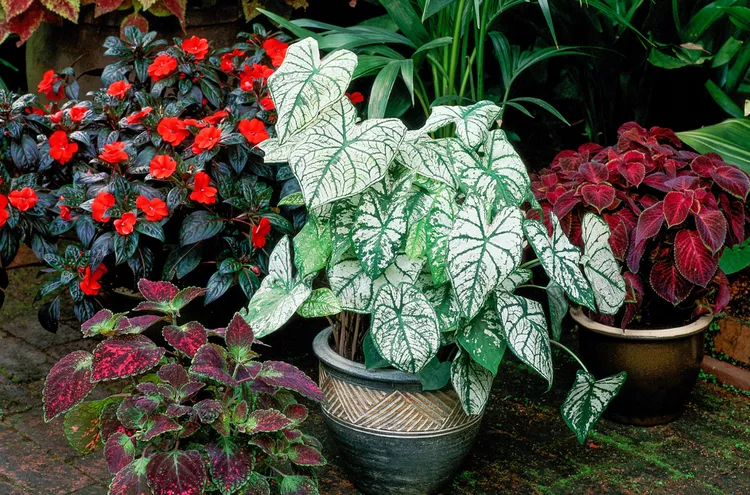
Coleus has colorful leaves all summer that stand out against the deep green foliage and red stems of roselle. Select varieties that include burgundy or red, such as ‘ColorBlaze Rediculous’ or ‘ColorBlaze Wicked Witch’.
Nasturtium
Nasturtium will provide a flowering skirt at the base of a roselle plant. And like roselle, its leaves and flowers are edible.
New